
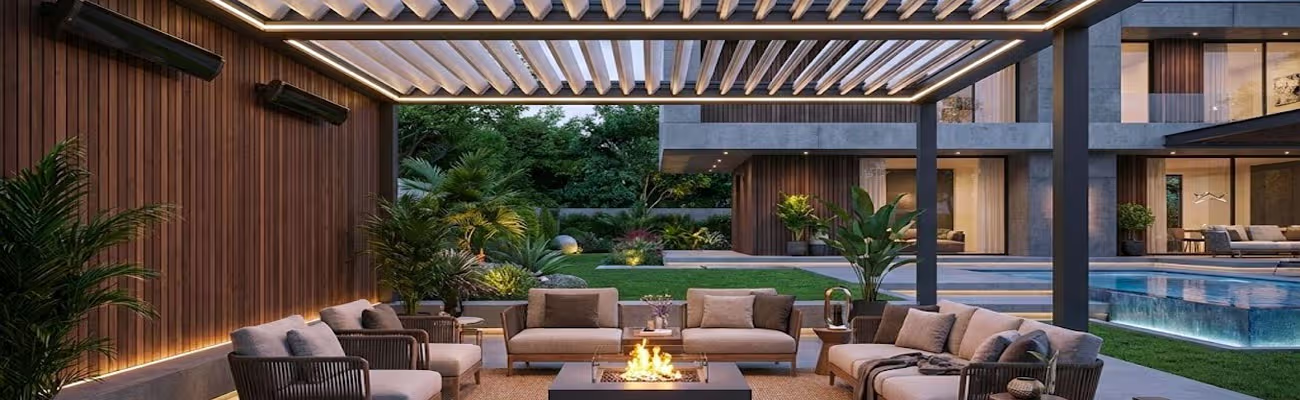
We often hear that infrared heating is "the best" option for a terrace. That is often true — but only if you understand why, and under which conditions. Because the difference between a cheap, badly positioned infrared heater and a well-designed professional installation is huge. Here is what you really need to know before choosing or recommending a system.
Radiant heat versus convection: a fundamental difference
To understand infrared heating, you first need to move away from the usual idea of heating. A conventional heater warms the air, which then warms people through contact or air movement. This principle, known as convection, works well in an enclosed space — and very poorly outdoors, where warm air escapes immediately as soon as there is any wind.
An outdoor infrared heater works on a radically different principle: it emits thermal radiation that passes through the air without heating it, and is absorbed directly by solid surfaces — skin, clothing, flooring and furniture. It is exactly the same mechanism as the sun's warmth. You can be standing in the shade at 5°C and immediately feel warmer as soon as you step into a patch of sunlight: that is infrared.
Short-wave IR, medium-wave IR, long-wave IR: which one for which use?
Not all infrared heaters perform in the same way, and the wavelength emitted has a major impact on results depending on the environment. This point is often poorly explained, so here it is clearly.
- Long-wave infrared (IR-C): low surface temperature and soft, even heat distribution. Ideal for enclosed indoor areas or semi-covered spaces. In open outdoor environments, the radiant density is generally too low to compensate for heat losses linked to unconfined volumes and air movement.
- Medium-wave infrared (IR-B): a good compromise for sheltered terraces — under a pergola, roof extension or semi-enclosed area. Penetration is decent, and comfort is satisfactory in moderate conditions.
- Short-wave infrared (IR-A): high radiant density, deep penetration and strong performance even on fully open terraces exposed to wind. This is the benchmark for professional applications and unprotected outdoor spaces.
In short: the more open and exposed the space, the more you should move towards short-wave infrared. Choosing long-wave IR for an open restaurant terrace almost guarantees an underperforming installation, whatever wattage is stated on paper.
Why wattage alone is not enough to compare two heaters
This is the most common mistake made during the buying process. Two heaters both rated at 2,400 W can deliver very different comfort levels in real conditions. The electrical power consumed tells you nothing about how that energy is converted, distributed and ultimately perceived. Several technical factors play a decisive role.
Optics and heat distribution
The beam angle, reflector shape and optical quality define the area that is actually covered. A beam that is too narrow creates hot spots; too wide, and the radiation is dispersed without delivering real comfort. The best models allow the angle to be adjusted to suit the space.
Thermal stability
The quality of the heating element and outer casing determines how consistent the radiant output remains over time. A unit that loses efficiency after only a few hundred hours of intensive use is not suitable for a professional environment, even if it performs well when new.
Added to this are the quality of the protective rating (IP), resistance to repeated on-off cycles, and the precision of the mounting system itself (adjustable brackets, robust fixings). These are the details that make the difference between a satisfactory heater for a private balcony and a reliable solution for five restaurant services a week.
Infrared versus gas and convection: an honest comparison
Infrared heating offers clear advantages — but also limitations that are better understood before investing, rather than after installation.
| Criterion | Infrared | Gas / convection |
|---|---|---|
| Immediate comfort (heat-up speed) | High | Variable |
| Wind sensitivity | Low | High |
| Heats the surrounding air | No | Yes |
| Precise zone targeting | Very good | Moderate |
| Compatibility with renewable electricity | Yes | No |
What “well positioned” really means
This is often the least documented part of the project, yet it is the most critical. A few practical guidelines:
- Installation height: between 2.10 m and 2.60 m above floor level for even radiant coverage. Below that, the radiation becomes too concentrated over a limited area and may create discomfort. Above 2.60 m, performance drops noticeably and cold zones begin to appear between units.
- Angle of orientation: an adjustable bracket is essential to adapt the direction of the beam to the actual terrace layout — ceiling height, table positions and any obstacles.
- Overlap between heated zones: to avoid cold spots between two heaters, coverage areas should overlap slightly. This point is often overlooked when designing the installation layout.
These parameters explain why a prior thermal study is valuable for any project of meaningful size. A well-designed layout plan can save several units while improving real comfort at the same time.