
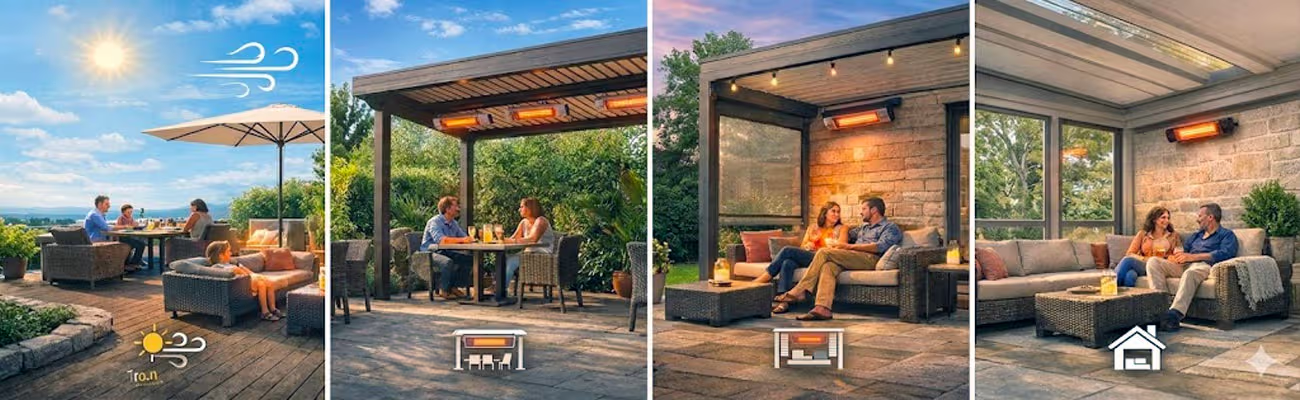
“Open terrace”, “pergola”, “canopy”, “partly enclosed” often describe very different physics. The right choice depends on real openness and on your occupied zones—not on a single “most powerful” unit.
1) Classify your terrace in 2 minutes (4 levels)
| Level | Description | Winning strategy |
|---|---|---|
| 1. Fully open | No roof / very high roof, direct wind | Strict zoning + multiple heat points + focused radiation |
| 2. Under canopy/pergola | Roof present, sides open | Even coverage + precise aiming |
| 3. Partly enclosed | Screens/panels on 1–2 sides | Lower losses + more stable comfort + zone control |
| 4. Enclosed | Veranda-like (near indoor) | “Indoor” comfort logic + moderate output + control |
Rule of thumb: any reduction of airflow—even partial—can dramatically improve comfort and reduce required heat points.
2) The most common mistakes
Mistake #1: sizing “per m²”
A terrace is rarely one zone. A table, a lounge and a service path are three uses—often three zones.
Mistake #2: mounting too high
Higher mounting can reduce radiant density. You “cover more”, but warmth becomes less felt.
Mistake #3: poor aiming
A radiant heater must “see” the occupied zone. If you heat empty space, you lose comfort fast.
Quick check: if the floor feels warm but people don’t, it’s usually geometry (height/angle/distance).
3) Pro solutions by terrace type
- Split the space into zones and design zone-by-zone
- Keep height under control; aim into the occupied area
- Use multiple heat points rather than one “big” unit
Goal: radiant density on people—not “heating the whole terrace”.
- Ceiling/structure mounting for even coverage
- Fine aiming towards seating
- Long spaces: split into 2–3 zones
In this scenario, comfort is predictable: stable geometry and better heat distribution.
- Lower losses → heat feels stronger
- Often fewer units needed; better controllability
- Zone control/dimming recommended (pro)
Keep safety clearances and choose the right IP rating for the environment.
In near-indoor conditions, you can plan “room comfort” while keeping the direct feel of radiant heat.
- Moderate output, even distribution
- Control (thermostat/controller) recommended
- Avoid local overheating
4) Quick checklist before buying
Questions
- What is the truly occupied zone?
- What mounting height is available?
- Where does wind typically come from?
- How many zones (table/lounge/path)?
- Can you add side protection?
Target result
- Felt warmth in 1–3 minutes
- Stable comfort despite airflow
- No harsh glare
- Zone control (pro) or simple use (home)
5) FAQ
Yes. Reducing airflow can dramatically cut losses and stabilise comfort—often the best “upgrade” you can make.
Because it’s often mounted too high or spreads too wide. Multiple aimed heat points create more even comfort.
Depending on wind exposure and shelter, compare Heatstrip infrared heaters and Heatscope heaters.