
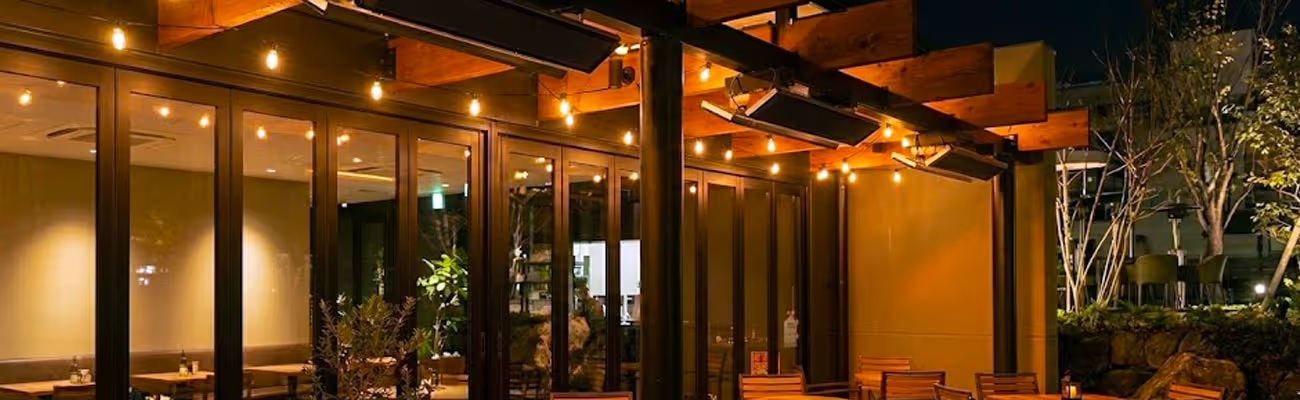
If you run a restaurant, café, bar or hotel, an empty terrace as soon as temperatures drop is a direct loss of turnover. A well-designed professional outdoor heating installation can extend the terrace season, keep guests comfortable from autumn to spring and make outdoor seating usable for longer services. Here is the professional method for choosing the right technology, power and installation layout.
Why short-wave infrared heating works so well on professional terraces
Outdoor heating is not simply a question of power. The main difficulty is heat loss. A convective heater warms the air first, and that warm air is quickly carried away by wind, open façades or constant movement around the terrace.
Short-wave infrared heating works differently. It sends radiant heat directly towards people, tables and surrounding surfaces, in the same way sunlight is felt on the skin. Comfort is therefore more stable on open or semi-open terraces, even when the air is moving.
For restaurants, cafés and hotels, the benefits are practical and measurable:
- Wind resistance: radiant heat is far less affected by air movement than gas patio heaters or convective systems.
- Efficient use of energy: heat is directed towards occupied zones instead of trying to warm the whole outdoor volume.
- Immediate comfort: guests feel the heat quickly, without long preheating times.
- Discreet integration: professional units can be mounted on façades, pergolas, awnings or covered structures.
- Low-glare ambience: modern ceramic-glass emitters reduce visible red light and preserve the atmosphere of the venue.
What makes professional terrace heating different
A heater used occasionally at home does not face the same constraints as equipment installed in a commercial venue. Professional terrace heaters must withstand repeated switching, long operating hours, humidity, grease particles and temperature changes.
Equipment selected for restaurants, cafés, bars and hotels must therefore be robust: protected wiring, reliable brackets, weather-resistant housings and components designed for intensive use. This is where professional ranges make a real difference.
Design also matters. Guests come for comfort and atmosphere. A heater that is bulky, badly positioned or too bright can damage the experience. Slim black or brushed-metal infrared heaters usually integrate more naturally into a terrace, pergola or façade.
How to size a professional outdoor heating installation
Sizing is the step that determines whether the project works. Too little power creates cold zones between tables. Too much power increases electricity consumption and can make certain seats uncomfortable. The right solution depends on surface, wind exposure, mounting height and the way the terrace is used.
| Criterion | Recommendation for a professional terrace |
|---|---|
| Thermal power | Allow around 250 to 300 W per m² for open or semi-open terraces. Sheltered covered areas may need closer to 150 to 200 W/m². |
| IP rating | Choose at least IP65 for exposed outdoor use, with protection against rain, water spray and dust. |
| Mounting height | A height between 2.10 m and 2.60 m usually provides a balanced spread of heat without excessive intensity. |
| Orientation | Adjustable brackets help aim the heat towards tables, counters or waiting areas. |
| Electrical supply | Check the total installed power early so the switchboard and protection devices are correctly specified. |
Electric outdoor heating and changing regulations
Many cities are restricting or reviewing gas patio heating, especially on public terraces. The direction is clear: venues need cleaner, more controllable and easier-to-manage outdoor heating solutions.
Electric infrared heating is a coherent alternative. It creates no direct CO₂ emissions at the point of use, avoids gas bottles and can be combined with a green electricity contract. It also removes the operational burden of storing, replacing and securing gas cylinders.
Maintenance is simpler too. There are no burners, pressure regulators or gas connections to check. Regular visual inspection of brackets, cables and housings is usually enough for routine operation.
Control accessories: comfort without wasting energy
Good heaters are only part of the project. Dimmers, timers, presence detection and zone control help adapt the heat output to real conditions and avoid heating empty tables.
Power controllers are useful because a mild evening does not need the same output as a cold winter service. Timers prevent heaters from being left on after closing, while presence sensors are valuable on terraces with irregular occupancy.
More advanced systems allow centralised or smartphone control, making it easier to match heating schedules with reservations, weather forecasts and service hours.
Frequently asked questions about professional outdoor heating
Can infrared heaters be installed under an awning or pergola?
Yes, provided the manufacturer’s minimum distances and installation rules are respected. Professional heaters are commonly installed under awnings, pergolas and covered terraces with suitable brackets.
How long does a professional infrared emitter last?
Quality professional emitters often last several thousand operating hours. The exact lifespan depends on the model, installation conditions and daily use.
Is infrared heat comfortable for guests?
Yes. Properly positioned infrared heaters provide direct, gentle heat that guests feel quickly. Low-glare models also preserve the visual atmosphere of the terrace.
Is authorisation needed for a terrace heating installation?
If the terrace is on public land, local authorisation is often required. On private property, rules are usually simpler, but it is still wise to check with the local authority and insurer.
For a pergola or professional terrace, compare Heatstrip infrared heaters and Heatscope heaters according to mounting height, wind exposure and the areas to cover.
Professional patio heater
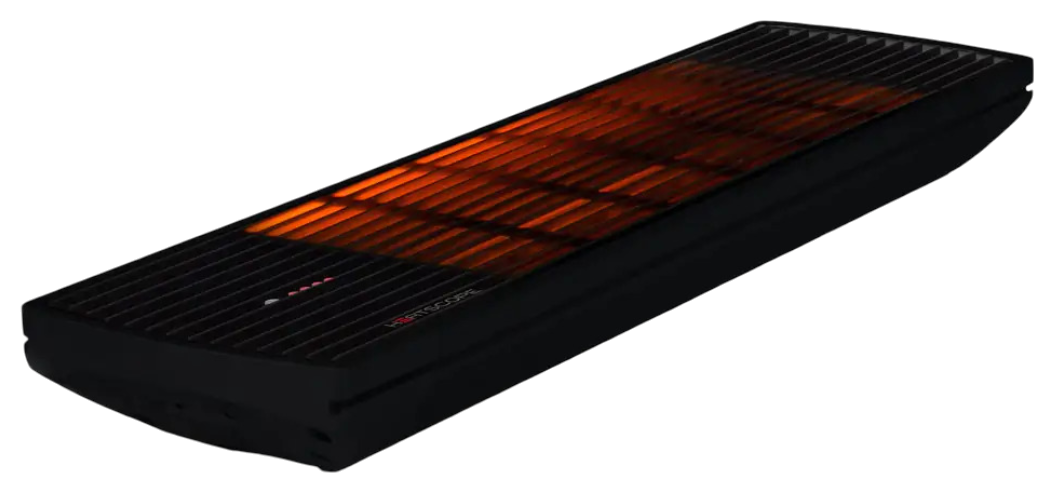
Professional Use & Exposed Areas • All Black Design • Carbon Fibre HEATSCO…

Far Infrared Heating • 3600W • Extra-Long Format • Off-White Finish HEATST…

Premium infrared heater • Integration & discretion • 3000WHeatscope® Pure White:…

Premium Infrared Heating • Design & Performance • 3000W Heatscope® Pure Al…

Premium Infrared Heating • NEXT Series • 3000W • Ref: MHS-NM3000AB.100 Hea…

Premium Infrared Heating • NEXT Series • 3000W • Ref: MHS-NM3000WT.100 Hea…